

01Origins · 9th – 11th century
Before the court,there was the kiln
Ruzhou, Henan · the clay country of the north.
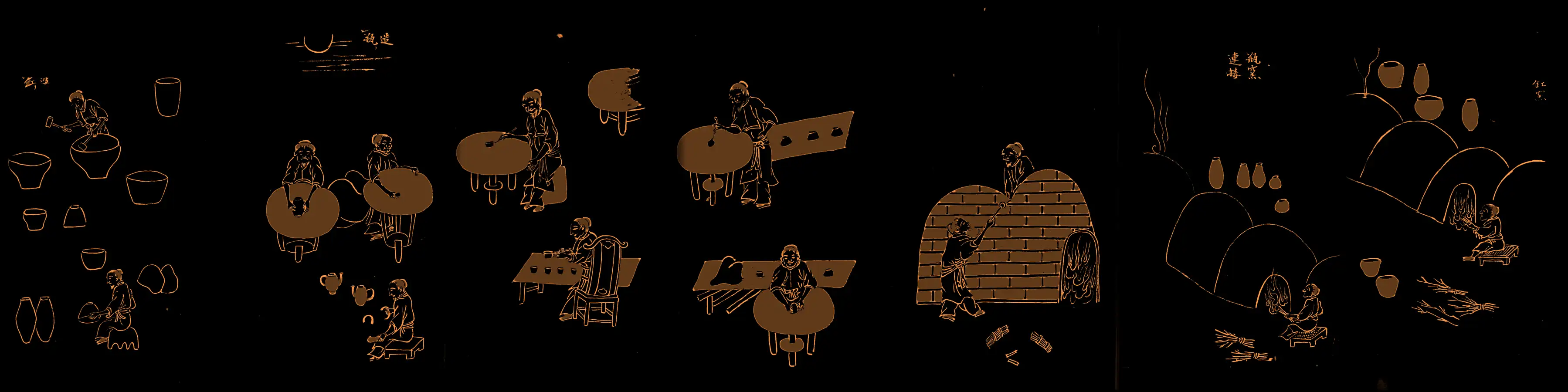
Long before any emperor asked for it, the potters of Ruzhou were firing bowls, ewers and cups for everyday tables. As early as the Tang dynasty, the kilns of nearby Lushan were already famous. Earth, water and fire — and centuries of practice — prepared the ground for Ru ware.
- IRefine
- IIThrow
- IIITrim
- IVGlaze
- VFire
- VIUnload
Peak kiln temperature
As early as the Tang dynasty, a writer praised the “flower porcelain” of Lushan — a few miles from where the Ru kilns would later stand.
02Rise · Northern Song
Chosenby the court
Agate in the glaze, for the palace alone.
The Song court found fault with its white Ding porcelain, and ordered Ruzhou to fire celadon instead. Of every kiln that answered, Ru was judged the finest. Its potters ground agate into the glaze, and only the pieces the palace turned away were ever allowed to be sold.
Ru ware is fired for the palace. There is agate in its glaze; only the pieces the court rejects may be sold.Zhou Hui, Qingbo Zazhi, Southern Song
- IThe court finds fault with its white Ding ware
- IIRuzhou is ordered to fire celadon
- IIIAgate is ground into the glaze
- IVOnly the pieces the palace refuses may be sold
Finding fault with its white Ding ware, the Song court “ordered Ruzhou to make celadon” — and of every kiln that answered, Ru was the finest.
03Zenith · 1086 – 1106
The skyafter rain
Northern Song court · first of the five great kilns.
For about twenty years, Ru ware was fired for the palace alone: a quiet sky-blue glaze, a fine crackle like crab claws, and three tiny “sesame” marks under the foot where it rested in the kiln. In the capital, Bianjing, merchants and camel trains crowded through the city gates; across the sea, Korean celadon was likened to “the new wares of Ruzhou”.
The blue of the sky where the clouds part after rain — make that colour.Attributed to Emperor Shizong of the Later Zhou; the Song held it as the highest ideal of celadon.
Fired for the palace alone
- RuBaofeng, HenanSky-blue glaze
- GuanKaifeng / HangzhouPurple mouth, iron foot
- GeZhejiang (debated)Gold-thread crackle
- JunYuzhou, HenanKiln-changed glaze
- DingQuyang, HebeiIvory white, tear drips
In 1123 the Song envoy Xu Jing wrote that the finest Korean celadon resembled “the new wares of Ruzhou”.
04Plunder · 1127 – 1933
The firethat ended it
Fire, ruin, and the long silence of the kilns.
In 1127 the Jurchen armies took the Song capital. The court fled south, and the Ru kilns went cold — the craft was lost for eight centuries. The pieces that survived in the imperial collection were scattered again: by the burning of the Old Summer Palace in 1860, and the occupation of Beijing in 1900. In 1933 the Palace Museum packed its treasures into crates and carried them south, away from war.
The Ru glaze was lost
- 1127The Jurchen take the Song capital; the Ru kilns go cold
- 1860Anglo-French forces loot and burn the Old Summer Palace
- 1900The Eight-Nation Alliance enters Beijing; the palaces are plundered again
- 1933The Palace Museum crates its treasures and carries them south
05Today · 1986 – 2026
Foundagain
National intangible cultural heritage of China.
In 1986 the Ru kiln site was found at Qingliangsi, Baofeng; in 2000 archaeologists reached the heart of the imperial workshops. Potters have since rediscovered the sky-blue glaze, and in 2011 the craft of firing Ru ware was listed as national intangible cultural heritage.
Song-dynasty Ru ware that survivesAbout 90, by the Palace Museum’s count
Paid for a Ru washer at Sotheby’s, 2017A record for Chinese ceramics at the time
Listed as national intangible heritageThe craft of firing Ru ware
06A gift of state · Sky Celadon
A thousand years on,still a gift of state
Given to the guest you honour most.
In China, Ru ware is still among the most precious of porcelains, kept by collectors and museums alike. It is the gift given with the most care — to the guests one honours most, and by the state to heads of state.
- State giftPresented to leaders of Israel, Japan, South Korea and others
- 2010Named a head-of-state gift of the Shanghai World Expo
- On displayIn the Great Hall of the People and the Palace Museum
We hope it will come to your table too — for the guests you honour most.
One vessel, a thousand years